Measure response from offline media and sampling
Offline activity creates attention, but brands need a way to understand which placements, messages or activations drive response. Zamplit gives offline activity a structured digital layer — tracking response by source, placement or message to inform future media and campaign planning.
Why product trial changes the answer
When people actually use the product before they answer, the quality of the response changes — and so does what a brand can do next.
OOH, events, print, in-store and experiential activity can be powerful, but brands often struggle to see which parts of the activity created meaningful customer response.
QR codes and offline sources can connect to Zamplit journeys, and sampling gives people a reason to act — so Zamplit gives offline activity a structured digital layer you can measure.
You see which placements, messages and partners drove response — Zamplit measures the trackable action layer, not every person exposed.
What you gain from real product trial
- A trackable action layer
- Placements compared by response
- Offline linked to real action
- Creative routes compared
- Planning informed by response
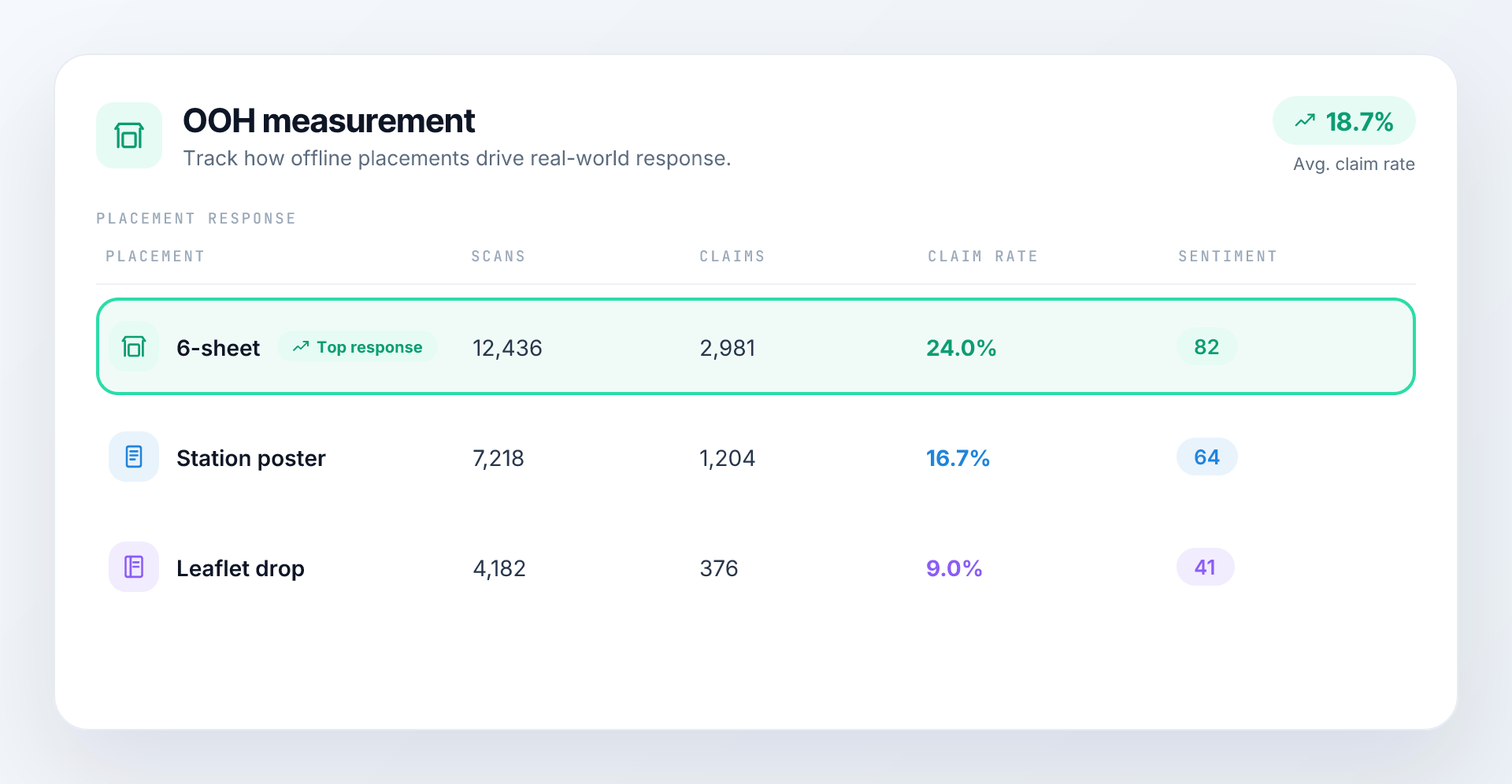
How ooh measurement campaigns can look with Zamplit
Example brief: A soft drinks brand runs QR-led OOH activity and wants to understand which placements drive the strongest response.
This is one example journey. Zamplit campaigns can be shaped around different audiences, channels, questions and outcomes.
The questions this can answer
Every Zamplit campaign can be shaped around the questions a brand needs to answer. The examples below show the types of signals product trial can help uncover.
Outputs you can act on
Insight
What the brand learns from real product trial.
- Source-level response
- Placement comparison
- Claim response
- Purchase intent
- Audience signals
Decision
How the findings shape the next move.
- Back the best placements
- Compare creative routes
- Choose media partners
- Re-plan the buy
- Improve future sampling
Activation
How the outputs are used beyond the campaign.
- Source-level reporting
- Placement comparison
- High-intent audiences
- Follow-up segments
- Exportable signals
Where brands put product trial to work
A few of the situations where brands use Zamplit — each one shaped around a different objective, audience and next action.
Track scans, visits or claims from offline placements, QR codes or source links.
See which locations, creative routes or media sources drive the strongest engagement.
Turn an offline interaction into a sample claim, feedback journey or offer action.
Understand who engaged, what they claimed and what they did next.
Compare claim rate, feedback completion and purchase intent by placement or campaign source.
Measure response from the trackable action layer, not every person exposed to the campaign.
Keep exploring
How to measure experiential marketing in a way that goes beyond footfall and guesswork
Experiential marketing and product sampling can create strong real-world engagement, but they are often some of the hardest activities to evaluate clearly.…
Read article →ArticleHow to increase product awareness in a way that is easier to measure
If a brand wants to grow, product awareness usually matters. People are unlikely to buy something they have never heard of, never…
Read article →Article12 product sampling ideas that do more than just give products away
Product sampling can be one of the most effective ways to get a product into the right hands, create genuine trial, and…
Read article →Give offline campaigns a measurable next step
Tell us what you want this campaign to achieve and we'll shape the right sampling journey around it.