Market research powered by real product trial
Most research asks people what they think they might do. Zamplit lets you ask what they think after they have actually experienced the product — so you can understand appeal, barriers, value perception and purchase intent with grounded, structured feedback.
Why product trial changes the answer
When people actually use the product before they answer, the quality of the response changes — and so does what a brand can do next.
Many research exercises ask people what they think they might do. Without real product experience, feedback stays abstract and assumptions go untested.
Sampling lets brands ask people what they think after actual product use. People respond differently once they have tried the product, feedback becomes more grounded, and you can see the real barriers, motivators and the language customers use to describe the product.
You act on grounded feedback — sharpening positioning, messaging and what to test next, instead of guessing.
What you gain from real product trial
- Feedback based on real use
- Stronger purchase intent signals
- Clearer barriers and motivators
- Better customer language
- More actionable next steps
How market research campaigns can look with Zamplit
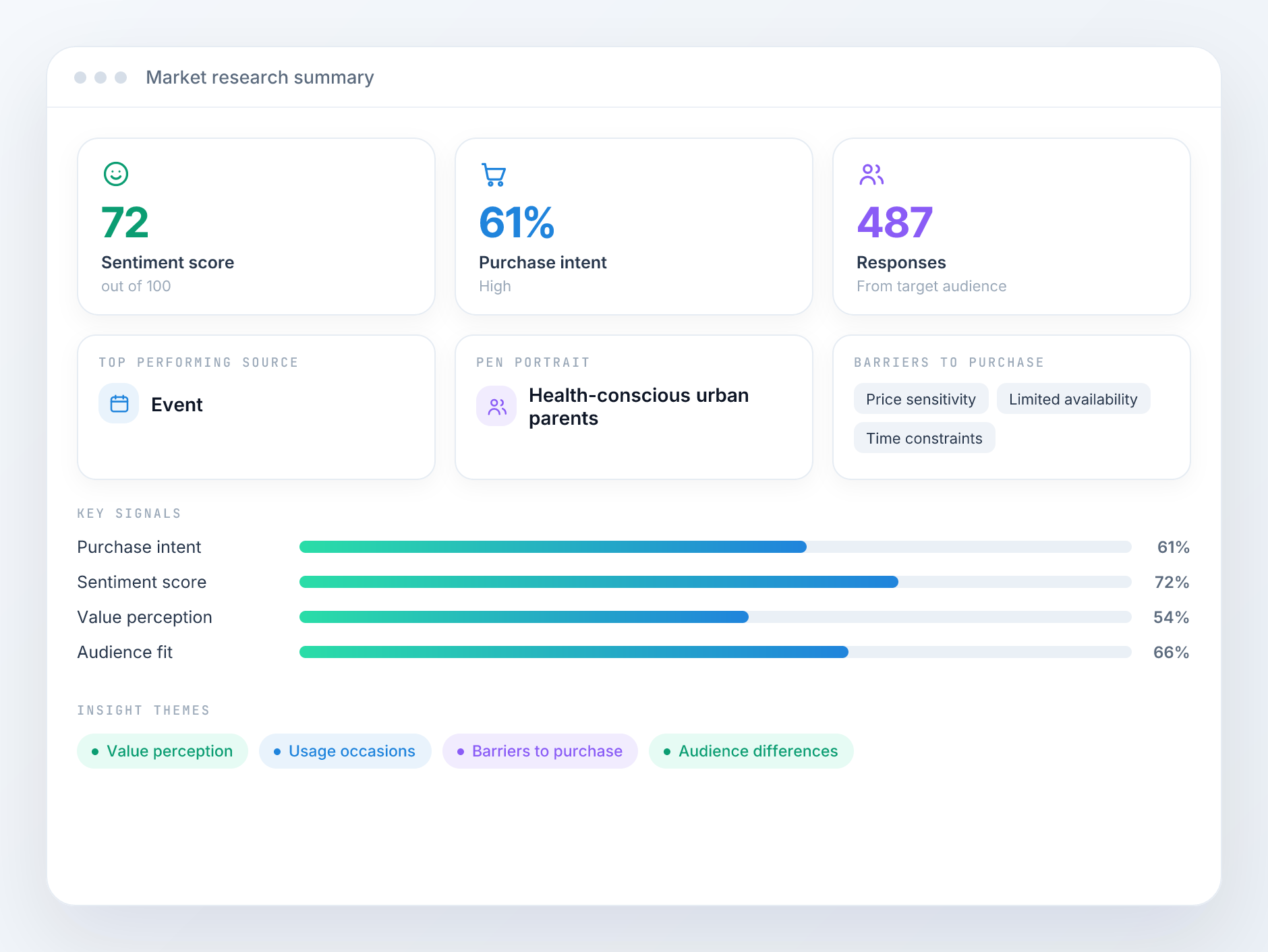
Example brief: A plant-based snack brand wants to understand whether its new high-protein range appeals to busy parents before committing to a wider launch.
This is one example journey. Zamplit campaigns can be shaped around different audiences, channels, questions and outcomes.
The questions this can answer
Every Zamplit campaign can be shaped around the questions a brand needs to answer. The examples below show the types of signals product trial can help uncover.
Outputs you can act on
Insight
What the brand learns from real product trial.
- Satisfaction
- Purchase intent
- Value perception
- Audience themes
- Barriers to purchase
Decision
How the findings shape the next move.
- Launch, refine or retest
- Improve messaging
- Compare audiences
- Shape the next campaign
- Prioritise actions
Activation
How the outputs are used beyond the campaign.
- CRM-ready audiences
- Paid media segments
- Follow-up opportunities
- High-intent responders
- Exportable customer signals
Where brands put product trial to work
A few of the situations where brands use Zamplit — each one shaped around a different objective, audience and next action.
Capture what people think after they have actually tried the product, not just reacted to an idea.
Understand how customers respond to taste, packaging, price, format, value and overall product fit.
Identify what would stop someone buying, switching or recommending the product after trial.
See which customer groups show the strongest satisfaction, purchase intent and product fit.
Use open feedback to understand how customers describe the product in their own words.
Turn trial feedback into clearer messaging, targeting and follow-up decisions.
Keep exploring
How to increase product awareness in a way that is easier to measure
If a brand wants to grow, product awareness usually matters. People are unlikely to buy something they have never heard of, never…
Read article →ArticleHow product sampling can increase product awareness more effectively
A lot of product awareness activity is built around visibility alone. That can be useful, but visibility is not the same as…
Read article →ArticleHow to measure experiential marketing in a way that goes beyond footfall and guesswork
Experiential marketing and product sampling can create strong real-world engagement, but they are often some of the hardest activities to evaluate clearly.…
Read article →Want to learn what customers think after real product trial?
Tell us what you want this campaign to achieve and we'll shape the right sampling journey around it.